
Imagine an aircraft manufacturer shipping a new jet without a single test flight. Unthinkable, right? Yet every week, businesses release software to paying customers without proper quality assurance — and pay for it in outages, lost deals, and one-star reviews.
Software testing services solve this problem. By combining skilled QA engineers, proven testing methodologies, and modern automation tools, professional testing teams catch defects before your users ever see them.
In this article, we’ll cover what software testing services include, the 8 types of testing every business application needs, the top automation testing tools QA experts use in 2026, and why more companies than ever are outsourcing QA to dedicated testing partners.
What Are Software Testing Services?
Software testing services are professional quality assurance (QA) solutions delivered by dedicated testing specialists who verify that an application works as intended — functionally, visually, and under load — before and after release. These services span manual testing, test automation, API testing, performance testing, and security testing, and are typically delivered by an outsourced QA team or through IT staff augmentation.
Unlike developers testing their own code, independent QA engineers bring objectivity, specialized tooling, and structured test coverage that catches the edge cases in-house teams miss.
8 Types of Software Testing Every Business Application Needs
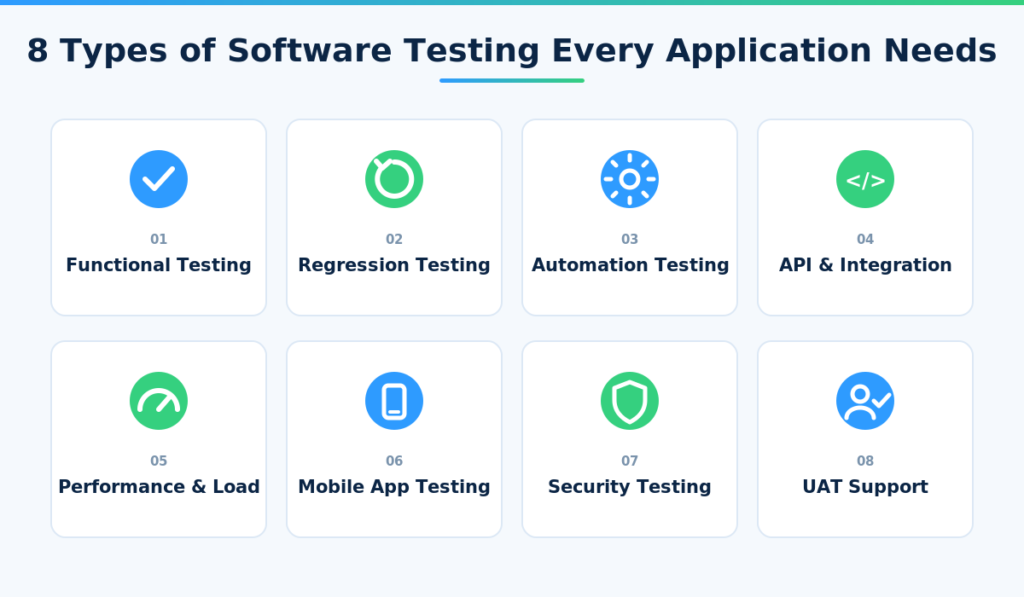
1. Functional Testing
Verifies every feature works according to requirements — logins, checkouts, workflows, and permissions. This is the foundation of all QA testing services.
2. Regression Testing
Confirms that new code doesn’t break existing features. Automated regression suites are the single biggest driver of release velocity for growing product teams.
3. Automation Testing
Converts repetitive manual test cases into scripts that run automatically in your CI/CD pipeline using tools like Playwright, Cypress, and Selenium — cutting testing time from days to hours.
4. API & Integration Testing
Most business-critical failures happen between systems, not inside them. API testing with Postman, REST Assured, or contract testing catches integration defects early, where they’re cheapest to fix.
5. Performance & Load Testing
Simulates thousands of concurrent users with JMeter or k6 to find bottlenecks before launch day — not during it.
6. Mobile App Testing
Validates iOS and Android applications across real devices, screen sizes, and OS versions using frameworks like Appium and device clouds like BrowserStack.
7. Security Testing
Identifies vulnerabilities such as injection flaws, broken authentication, and misconfigurations before attackers do — aligned with OWASP standards.
8. User Acceptance Testing (UAT) Support
Structures the final business sign-off with test scenarios, defect triage, and go/no-go reporting so stakeholders approve releases with confidence.
Top Automation Testing Tools QA Experts Use in 2026
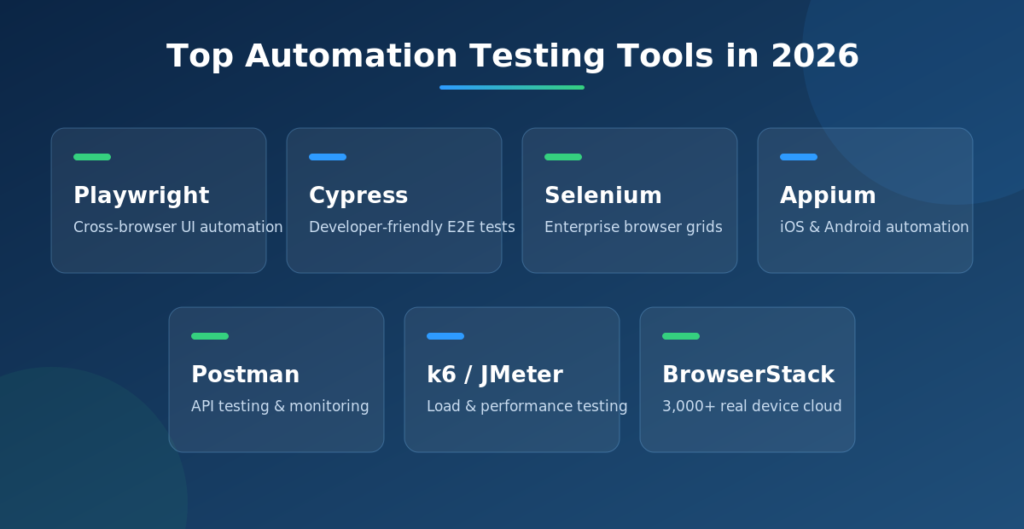
- Playwright — the modern standard for web UI automation. Fast, reliable cross-browser testing with built-in auto-waits that eliminate flaky tests.
- Cypress — developer-friendly end-to-end testing with time-travel debugging, ideal for JavaScript-heavy applications.
- Selenium — the veteran open-source framework, still essential for legacy browser coverage and enterprise grids.
- Appium — open-source mobile automation for native, hybrid, and mobile web apps across iOS and Android.
- Postman & Newman — API test creation, automation, and monitoring integrated directly into CI pipelines.
- k6 & JMeter — load and performance testing tools that simulate real-world traffic at scale.
- BrowserStack & LambdaTest — cloud device grids for testing on 3,000+ real browser and device combinations without maintaining a device lab.
The right toolset depends on your technology stack, release cadence, and budget — which is exactly what an experienced software testing company evaluates before writing a single test script.
6 Benefits of Outsourcing Software Testing Services
- Lower QA costs. Outsourced QA engineers typically cost 50–65% less than equivalent US/UK hires, with no recruiting, training, or bench costs.
- Faster releases. Overnight regression runs and automated pipelines mean developers get test results before their morning standup.
- On-demand scalability. Scale the testing team up for major releases and down between them — impossible with fixed in-house headcount.
- Independent objectivity. Third-party testers have no incentive to wave defects through; they validate against requirements, not assumptions.
- Access to specialized skills. Automation architects, performance engineers, and security testers on tap, without hiring each specialty full-time.
- Developer productivity. Your engineers build features instead of clicking through checkout flows — the highest-value use of their time.
Why Choose BestPeers as Your Software Testing Company?
BestPeers is a CMMI Level 3 certified IT services company delivering software testing services and QA staff augmentation to businesses across the US, UK, and worldwide. Our dedicated QA engineers specialize in full-cycle testing — functional, regression, automation, API, mobile, and performance — using the modern frameworks covered in this article, including Playwright, Cypress, Selenium, Appium, and k6.
We integrate directly into your tools, repositories, and CI/CD pipelines, work in your time-zone overlap, and hand over documented, version-controlled test suites that remain your asset. CMMI Level 3 certification means our testing follows defined, repeatable processes — not ad-hoc heroics.
Conclusion
Software quality is no longer a pre-launch checkbox — it’s a continuous discipline that determines how fast you can ship and how much your users trust you. Whether you need a full outsourced QA team, automation engineers to build your first regression suite, or specialists to load-test your next launch, professional software testing services deliver the coverage in weeks that in-house hiring delivers in months.
Frequently Asked Questions
What do software testing services cost?
Most providers price by dedicated engineer per month or by project scope. Outsourced QA engineers typically cost 50–65% less than equivalent US/UK hires; a two-to-three-person team covering manual plus automation testing is the most common starting point for mid-size products.
What is the difference between manual and automation testing?
Manual testing relies on human testers executing scenarios — best for exploratory, usability, and one-off testing. Automation testing uses scripts that run repeatedly without human effort — best for regression, smoke, and API checks that run on every release. Mature QA strategies combine both.
How quickly can an outsourced QA team start?
With an established partner, expect onboarding in one to two weeks and a working automated regression suite covering your highest-risk flows within eight to twelve weeks.
Should QA be part of the development team or independent?
Both models work, but independent QA — in-house or outsourced — consistently catches more defects because testers validate against requirements rather than the developer’s mental model of the feature.