Modern businesses depend on software to manage operations, improve customer experiences, automate workflows, and make data-driven decisions. The biggest challenge many organizations face is choosing between custom software vs off-the-shelf software. While ready-made tools offer quick deployment and lower upfront costs, custom-built solutions provide greater flexibility, scalability, and competitive advantages.
At BestPeers, we help businesses choose and develop the right technology solutions based on their long-term goals, operational needs, and digital transformation strategies.
Custom Software vs Off-the-Shelf Software
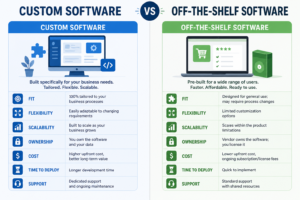
The main difference between custom software and off-the-shelf software is personalization. Custom software is developed specifically for your business processes, while off-the-shelf software is designed for a broad audience with general features.
- Choose custom software if you need scalability, advanced integrations, AI capabilities, and unique business workflows.
- Choose off-the-shelf software if you need a quick, affordable, and ready-to-use solution for common business tasks.
Understanding Custom Software Development
Custom software is a tailor-made digital solution developed specifically to meet the unique needs of a business. Unlike generic applications, custom software is built around your workflows, operational challenges, customer expectations, and future scalability goals.
Businesses often invest in custom solutions when existing tools cannot fully support their processes or when they want a competitive advantage through technology innovation.
At BestPeers Software Development Services, organizations can build scalable, secure, and future-ready applications designed around their exact business requirements.
Key Features of Custom Software
- Personalized functionality
- Scalable architecture
- Advanced system integrations
- Better security and data control
- Flexible UI/UX design
- AI and automation capabilities
- Ownership of the platform and source code
Custom solutions are commonly used in industries such as healthcare, fintech, logistics, retail, eCommerce, insurance, and enterprise operations.
Advantages of Custom Software
1. Built Specifically for Your Business
Custom applications are designed according to your exact business model, processes, and operational goals. This eliminates unnecessary features and improves efficiency.
2. Better Scalability
As your business grows, custom software can easily evolve with new features, integrations, and technologies.
3. Seamless Integration
Custom platforms can integrate smoothly with CRMs, ERPs, payment systems, analytics tools, and third-party APIs.
4. Enhanced Security
Businesses dealing with sensitive data often prefer custom-built systems because they offer stronger security controls and compliance flexibility.
Organizations looking for secure enterprise-grade systems often combine custom development with Cyber Security Services to improve protection against evolving cyber threats.
5. AI-Powered Innovation
Modern custom software can include AI-driven features such as:
- Predictive analytics
- Intelligent automation
- AI chatbots
- Recommendation engines
- Machine learning models
Companies increasingly adopt Artificial Intelligence Services and Generative AI Solutions to automate workflows and improve decision-making.
6. Improved User Experience
Custom software provides better user experiences because the interface is designed specifically for your employees and customers.
Businesses often improve usability through professional UI/UX Design and Development Services.
Disadvantages of Custom Software
Higher Initial Investment
Custom development requires a larger upfront budget compared to subscription-based SaaS products.
Longer Development Timeline
Building software from scratch can take several weeks or months depending on project complexity.
Ongoing Maintenance
Custom applications require continuous updates, testing, and technical support.
Businesses often reduce operational challenges through managed DevOps Services and dedicated support teams.
When Should You Choose Custom Software?
Custom software is ideal when:
- Your workflows are unique or complex
- Existing tools cannot meet business requirements
- You need advanced integrations
- Scalability is a priority
- Data security and ownership are critical
- AI and automation are part of your strategy
- Your business needs competitive differentiation
Companies undergoing digital transformation frequently invest in Enterprise IT Solutions to modernize operations and improve long-term efficiency.
What is Off-the-Shelf Software?
Off-the-shelf software refers to ready-made applications designed for mass use. These solutions are created to solve common business problems across different industries.
Popular examples include:
- Gmail
- Microsoft Office
- Slack
- Shopify
- Zoom
- Salesforce
- Tally
These products are usually available through subscriptions or licensing models and can be deployed quickly.
Advantages of Off-the-Shelf Software
1. Faster Deployment
Businesses can start using the software immediately without long development cycles.
2. Lower Upfront Costs
Subscription-based pricing makes off-the-shelf solutions affordable for startups and small businesses.
3. Easy Maintenance
The software provider handles updates, bug fixes, and server maintenance.
4. User-Friendly Experience
Most SaaS products are designed for easy adoption with minimal training.
5. Access to Modern Features
Many SaaS platforms now include AI-powered capabilities like automation, analytics, and smart recommendations.
Businesses can further enhance these platforms with AI Chatbot Development Services and intelligent workflow automation.
Disadvantages of Off-the-Shelf Software
Limited Customization
You may need to adapt your business processes to fit the software instead of the software adapting to your business.
Recurring Subscription Costs
Monthly or yearly fees can become expensive as your business scales.
Vendor Dependency
You rely completely on the provider for updates, support, pricing changes, and feature availability.
Integration Challenges
Some ready-made solutions may not integrate well with existing systems or future technologies.
Custom Software vs Off-the-Shelf Software: Key Differences
Feature | Custom Software | Off-the-Shelf Software |
Development | Built for specific business needs | Built for mass users |
Cost | Higher upfront cost | Lower initial cost |
Scalability | Highly scalable | Limited scalability |
Flexibility | Fully customizable | Limited customization |
Ownership | Full ownership | Vendor-controlled |
Deployment Time | Longer | Faster |
Integration | Easier custom integration | May require workarounds |
Security | Advanced control | Shared infrastructure |
| Competitive Advantage | High | Limited |
AI is Changing Software Development
Today, businesses are no longer comparing only custom software vs off-the-shelf software. The real discussion is about how effectively software uses artificial intelligence, automation, and data intelligence.
AI-powered systems help organizations:
- Automate repetitive tasks
- Improve customer experiences
- Generate business insights
- Predict user behavior
- Optimize operations
- Increase productivity
At BestPeers AI & Machine Learning Services, businesses can build intelligent solutions powered by advanced analytics, automation, and machine learning models.
The Role of Data Analytics in Modern Software
Whether you choose custom or ready-made software, data plays a critical role in business success.
Companies now rely heavily on:
- Business intelligence dashboards
- Real-time reporting
- Customer analytics
- Performance monitoring
- Predictive insights
Businesses can improve data visibility using Power BI Services and Data Analytics Services for smarter decision-making.
Which Option is Better for Your Business?
The right choice depends on your business goals, budget, operational complexity, and long-term growth plans.
Choose Custom Software If:
- You need unique business functionality
- Your company is scaling rapidly
- You require high security and compliance
- AI and automation are important
- You want complete control over the platform
Choose Off-the-Shelf Software If:
- You need a solution quickly
- Your budget is limited
- Your business needs are standard
- You want minimal technical management
- You are a startup or small business
Final Thoughts
The decision between custom software vs off-the-shelf software is ultimately about balancing flexibility, cost, scalability, and long-term business value.
Off-the-shelf solutions work well for general operational needs and quick deployment. However, businesses aiming for innovation, scalability, automation, and competitive differentiation often benefit more from custom software development.
At BestPeers Technology Services, we help organizations design, develop, and scale intelligent digital solutions tailored to their business goals. From custom applications and AI-driven platforms to enterprise software and analytics solutions, our team delivers technology that supports long-term growth.