
Digital transformation keeps evolving, and new technologies are changing how companies modernize. From AI and cloud computing to generative AI, here is a closer look at the trends shaping industries in 2027.
- Agentic AI
Enterprises are moving beyond static automation to systems that can reason, decide, and act on their own. The agentic AI market is expected to reach about USD 93.2 billion by 2032. Businesses that once relied on fragmented tools are now building continuous, self-optimizing operations run by AI agents.
- Software development: AI agents support every phase of the lifecycle, helping teams ship faster and stay competitive.
- Insurance: faster claims processing and better fraud detection keep risk under control.
- Manufacturing: predictive maintenance, production sequencing, and quality checks run with minimal manual intervention.
- Retail, healthcare, BFSI, logistics, and telecom: agents handle high-volume tasks, sharpen decisions, and reduce operational drag.
The common outcome is more time for strategic work, fewer handoffs, faster turnaround, and better results. Organizations that move now will define the next operating model: automated, responsive, and built to scale. In 2027, simply adopting AI will not be enough. Speed of execution will set leaders apart.
- Generative AI
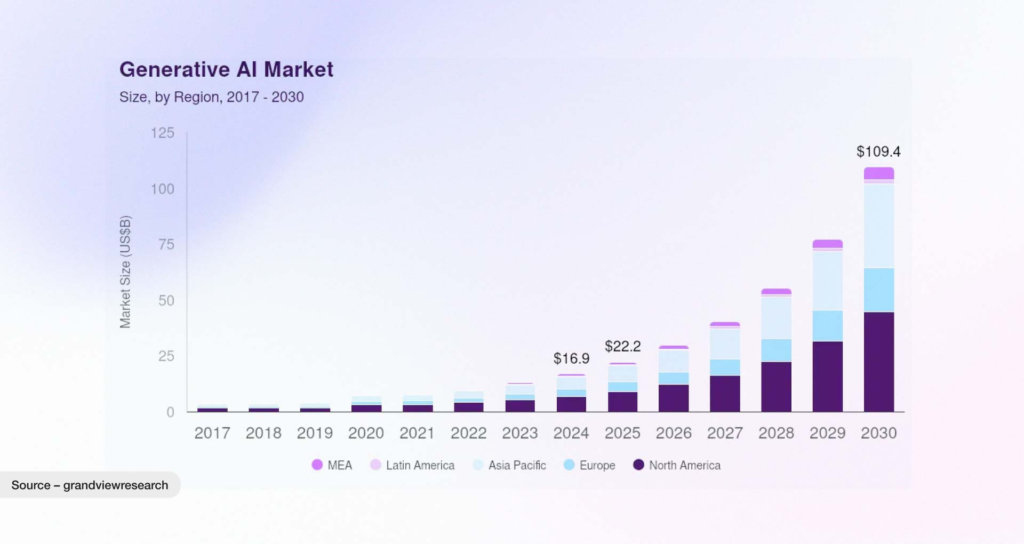
Generative AI has come a long way from early language translation and simple language models. Today it creates realistic text, images, video, and audio. Tools such as ChatGPT and DALL-E from OpenAI show how quickly it is changing industries worldwide.
In 2027, AI-powered large language models will keep getting better at writing, translating, powering chatbots, and producing creative content. Generative adversarial networks (GANs) will produce even more realistic images, video, and audio. By 2027, more than 80% of enterprises are expected to have GenAI-enabled applications running in production.
The future of digital transformation will use generative AI for personalized marketing campaigns, product innovation, and better customer service, creating tailored content that resonates with each audience.
- Artificial Intelligence and Machine Learning
AI and machine learning (ML) are core drivers for planning and executing digital transformation. They let companies build strategies on real-time market intelligence instead of piecemeal tactics across disconnected systems.
- AI mimics human intelligence to recognize and respond to behavior and events, and uses the insights from ML to create or adjust programs.
- ML applies big data to find and correlate patterns, giving insight into customer behavior and other events.
Together, they analyze information in real time, make IT operations and business processes more efficient, and help teams respond quickly to shifts in customer behavior, including early signs of declining sales.
Gartner projected that by 2026, organizations that operationalize AI transparency would see their AI models achieve a 50% improvement in business goals.
- AI-Driven Personalization
Hyper-personalized experiences have changed how businesses engage customers. Good customer experience now goes beyond treating people well. It drives loyalty, higher conversion rates, greater satisfaction, and ultimately more revenue. AI, machine learning, big data, and analytics are at the center of this shift.
Multichannel journeys matter more than ever, because customers expect smooth transitions between digital and physical touchpoints. Companies now use AI to deliver consistent, context-aware experiences across websites, mobile apps, social media, and physical locations, keeping customer data and preferences in sync on every channel.
Retail, financial services, hospitality, and travel are already gaining a competitive edge. Retailers, for example, use AI-powered analytics to tailor offers, optimize customer journeys, and improve the overall experience.
- Hyperautomation
Hyperautomation is spreading quickly across business operations and workflows. The market was valued at USD 46.4 billion in 2024 and is projected to grow at a 17% CAGR through 2034.
The goal of most adopters is the same: bring automation into as many processes as possible to cut manual work, reduce errors, and speed up operations and production.
- Composable Enterprise and Modular Architecture
Market analysis projects the composable infrastructure market to reach USD 39,366.6 million by 2032, a CAGR of 24.9%. That shows how strongly businesses believe in modular infrastructure.
With modular building blocks, APIs, microservices, and plug-and-play packages, companies can launch new features or update systems in days instead of months. This flexibility matters as market conditions and customer expectations change fast. Businesses are moving away from monolithic systems and toward composable architecture because it directly improves speed.
- Cloud Services
Scalability, agility, and security make cloud services a must-have for modern businesses. By 2027, more than 50% of businesses are expected to adopt cloud platforms to speed up their operations.
Enterprises can use the packaged business capabilities of cloud platforms, including hosted and managed platforms, applications, and data services, to launch differentiating digital initiatives, reach value faster, and avoid vendor lock-in.
- Data Analytics
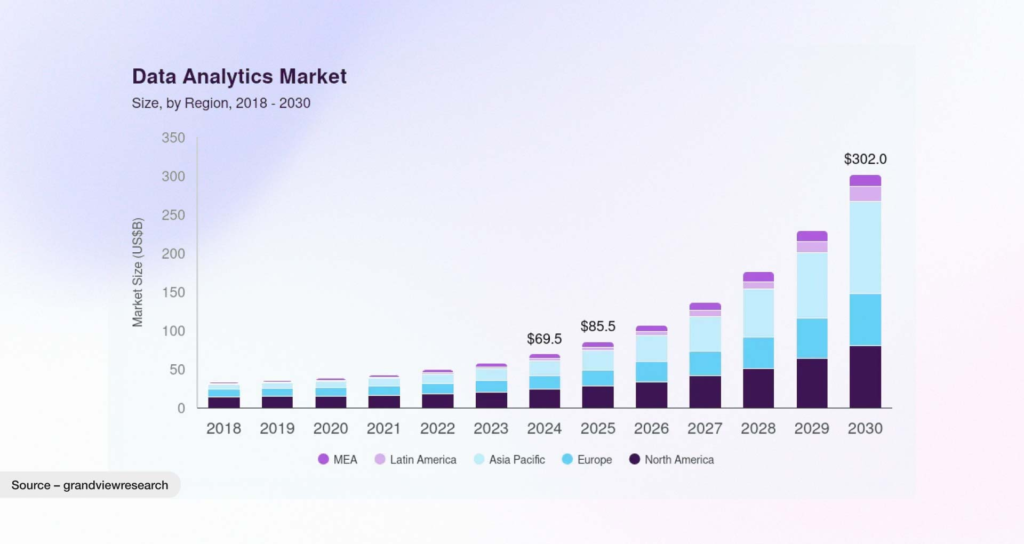
Organizations around the world generate huge volumes of data every day. Storing and processing that data is a challenge, and so is making sense of it.
Data and analytics go hand in hand. Analytics helps companies spot trends, answer questions, map out solutions, and understand why events happened. Big data analytics can process large datasets and extract the information needed to refine strategy and make better decisions.
A dedicated data analytics services provider can help you build an effective digital transformation strategy covering every stage, from planning and proof of concept to full implementation. Research suggests around 3 in 5 organizations are already using data analytics to drive major advances.
- Data Management
Data is central to digital transformation. From insight-driven decisions to better customer experiences and higher productivity, it all depends on strong data management. That covers collection, processing, and cleansing through to unification, integration, and distribution. Data management strongly influences both the speed and the scale of transformation. An experienced data engineering company can help you unify your data and integrate it accurately.
Gartner has found that involving Chief Data Officers (CDOs) in setting goals and strategy can increase the consistent delivery of business value by a factor of 2.6.
- Internet of Things (IoT)
IoT promises major efficiency gains across industries. In digital transformation, it brings digital capability to physical products. Data is central to both, and with the right IoT platform, companies can turn raw device data into useful business information and digitize physical products.
That data also creates a digital link between a company, its products, and its customers.
- Retail: real-time, actionable insights improve customer satisfaction.
- Healthcare: telemedicine is growing with advanced IoT capabilities.
- Manufacturing: IoT makes operations faster, safer, and more agile.
An IoT application development partner can help connect users and devices, supporting the whole lifecycle: requirements, architecture design, platform and app development, testing, and ongoing support.
- Edge Computing
As data volumes and speeds grow, edge computing offers relief. It cuts cloud latency, lightens the load on centralized servers, and makes infrastructure more flexible. With lower latency, higher bandwidth, and purpose-built devices, it brings efficiency to data-heavy operations.
- Manufacturing: real-time equipment monitoring for predictive maintenance.
- Healthcare: faster processing of wearable-device data for better patient care.
- Energy: better energy management and smoother integration of renewable sources.
- Phygital Convergence
Phygital convergence, the blending of physical and digital experiences, will keep growing in 2027. It uses AR, VR, and IoT to create immersive, interactive experiences.
Augmented reality overlays digital information on the real world. Virtual reality creates simulated environments for immersive use cases. IoT connects devices and collects data to link everything together. Businesses that use this convergence can offer more engaging customer experiences and blur the line between physical and digital.
- Quantum Computing
Quantum computing is set to change how we compute. It uses quantum bits (qubits) to solve complex problems much faster than conventional computers, and it could reshape many industries. Key areas include:
- Drug discovery and development
- Materials science
- Financial modeling
- Artificial intelligence and machine learning
Organizations that want to benefit should start learning how quantum computing works and bring in expert guidance early, so they are ready for the shift.
- Product Engineering
To transform digitally, businesses need to reinvent their product offerings while modernizing legacy systems. Product engineering services help companies keep delivering value even in uncertain times. Enterprises can build software products to improve employee productivity or to generate revenue.
The real power of these technologies comes from how they are combined in your digital transformation strategy. The global product engineering services market is expected to reach USD 1,979.79 billion by 2029, according to Data Bridge Market Research.
- The Low-Code Revolution
Low-code and no-code platforms are becoming central to successful digital transformation. Their drag-and-drop tools simplify building everything from basic apps to complex enterprise solutions, making development accessible to technical and non-technical users alike. By reducing the need for deep backend expertise, they speed up adoption, shorten time to market, improve interoperability, and encourage creativity. The low-code development market is expected to reach USD 187 billion by 2030.
- Metaverse
The metaverse blends virtual and physical worlds and continues to raise expectations across industries. Virtual fitting rooms in retail are a good example of its practical potential. The metaverse market is projected to reach USD 7,136.9 billion by 2035.
Other Trends to Watch
A few more technologies are also reshaping the digital landscape. 5G keeps improving connectivity and data transfer speeds, while cyber resilience and blockchain help protect organizations against threats across industries. Businesses that prioritize these trends are well placed for growth and innovation.
Benefits of Digital Transformation in Different Industries
Digital transformation matters for every modern business. If you need more motivation to start, here is what it offers across key industries.
Healthcare
- Faster response times through centralized access to patient data
- Lower infrastructure costs with digital health tools
- Accurate analysis of health data to personalize treatment plans
- A better patient experience with easy access to telemedicine
Retail
- Automation of complex, time-consuming, error-prone tasks
- More efficient supply chain management
- Greater agility and a smoother customer buying journey
- Faster response to customer needs and market trends
- Omnichannel shopping across digital channels
- Better customer focus through organized internal workflows
- New value propositions identified through data intelligence
FinTech
- Digital investors acquired through online services
- Less paperwork through robotic process automation
- Customized offerings built on consumer data analytics
- AI algorithms for upselling and cross-selling
- Blockchain for greater transparency and lower risk
Manufacturing
- Lower operating costs through the Industrial Internet of Things (IIoT)
- Higher productivity with automation software
- Data-driven risk analysis and decision-making
- Better product quality through real-time analytics
- A better customer experience with simpler online ordering
AdTech
- Sharper targeting and personalization in ad campaigns
- Better data analytics for insight and decision-making
- Automated ad serving and optimization for greater efficiency
- Smooth integration with emerging advertising technologies
- Greater agility in responding to market trends and consumer behavior
EdTech
- Lower administrative burden through digitalization
- Higher enrollment with self-service portals
- Immersive learning through user-friendly web and mobile apps
- Learning anytime, anywhere through online classrooms
- Progress tracking and personalized learning
We can help you assess your technology needs and build a clear, step-by-step plan.
How BestPeers Can Help You Accelerate Your Digital Transformation
BestPeers offers enterprise software development services backed by multi-domain expertise. We help organizations of every size build custom applications that fit their enterprise needs, and we have a proven track record serving global clients across many sectors.
As a leading digital transformation services provider, our certified professionals help you modernize your business with disruptive, practical solutions. We help you rethink the customer journey and adopt insight-led processes that deliver intuitive, high-quality experiences.
Let us help you create a digital strategy and roadmap aligned with your business goals. From data analytics and cloud application development to mobile app and IoT application development, our software product engineering services deliver next-generation solutions that speed up your digital journey.
Frequently Asked Questions
What happens if a business ignores digital transformation?
Ignoring digital transformation can lead to:
- Falling behind competitors
- Missing out on data-driven insights
- Failing to meet evolving customer expectations
- Inefficiency, higher operating costs, and difficulty adapting to market changes
How can small businesses approach digital transformation with limited resources?
Small businesses can start by:
- Choosing cloud-based solutions with pay-as-you-go pricing
- Starting with essential automation tools for core processes
- Focusing on digital marketing and customer engagement platforms
- Using ready-made software instead of custom development where possible
- Training existing staff on digital tools instead of hiring specialists
- Rolling out changes gradually, guided by clear ROI metrics
What are the risks of being a late adopter?
Delaying digital transformation can lead to:
- Loss of market share to more digitally advanced competitors
- Lower operational efficiency and higher costs
- Difficulty meeting modern customer expectations
- Trouble attracting and retaining skilled talent
- Greater vulnerability to digital disruption
- A reduced ability to adapt quickly to market changes